

Hospital pharmacists practise in complex clinical environments and while many pharmacists assume their employer’s arrangements or a general professional indemnity policy will be sufficient, there are important risks that may not be immediately obvious.
The information below highlights key considerations for hospital pharmacists when reviewing their professional indemnity insurance and explains why pharmacy specific cover matters.
Even when employed within a hospital or health service, pharmacists remain personally accountable for their professional decisions. Complaints, investigations, coronial matters or regulatory issues can arise long after an incident, and may not be fully covered by an employer’s policy.
Having your own professional indemnity insurance ensures that:
A common assumption: “I’m covered under a master policy”
Some pharmacists rely on master policies that cover multiple health professionals or entire organisations. While these policies may appear comprehensive, they can create unintended risks for individual pharmacists.
In many master or group policies, the total insurance limit is shared across all insured parties. This means:
For hospital pharmacists, this can be particularly concerning in large systems where multiple claims may arise in the same policy period.
The PDL Master Policy provides every individual pharmacist with their own coverage of $20,000,000, together with a range of policy sub limits providing additional benefits to you individually.
Pharmacists are often grouped under broad “allied health” insurance arrangements. While allied health professionals provide valuable services, their risk profiles, scope of practice and claim exposure may differ significantly from pharmacy.
When pharmacists are insured alongside other professions:
The PDL Master Policy is only for PDL member pharmacists.
When an incident occurs, early advice is critical. Some policies include deductibles or excesses that apply every time a claim or notification is made. A deductible or excess is an amount you need to contribute towards the claim, and upwards of $2,500 is commonly seen.
A policy with no excess for notifications or claims, such as the PDL Master Policy, is not only better for you financially. It also allows pharmacists to seek advice promptly, without second-guessing whether the amount involved is more than the excess on the policy. This may be important in hospital settings where incidents can involve internal investigations, open disclosure processes, or regulatory scrutiny.
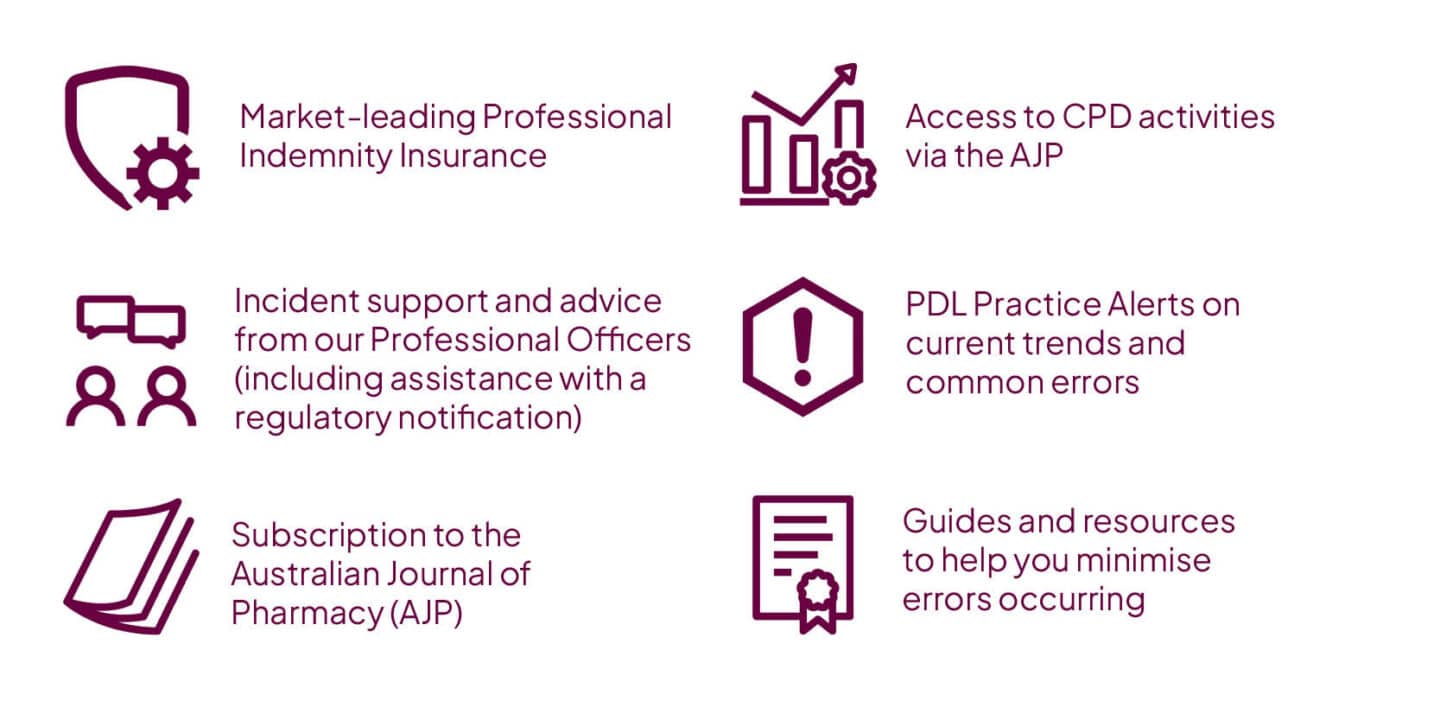
Professional indemnity insurance is not just about financial protection — it is also about who supports you when something goes wrong.
PDL provides:
This specialist support can be critical during what is often a stressful and unfamiliar process.
Pharmaceutical Defence Limited (PDL) is a not-for-profit organisation established by pharmacists, owned by pharmacist members, for pharmacists. The PDL Master Policy is designed specifically for pharmacists to reflect modern pharmacy practice and will continue to adapt as pharmacists’ roles evolve.
PDL members can call 1300 854 838 for advice and incident support from one of our Professional Officers.
Insurance issued by Guild Insurance Limited ABN 55 004 538 863, AFS Licence No. 233791 and subject to terms, conditions and exclusions. Guild Insurance supports PDL through the payment of referral fees. This information is of a general nature only. Please refer to the policy wording and policy schedule for details. For more information, call PDL on 1300 854 838
This content is available to PDL members only.
To continue reading please log in to the member portal or join PDL today.
Renew your PDL membership now and take a moment to review your Practice Profile, as updates have been made to our areas of practice. You can log in to the member portal using your email address or mobile number.
